Vesuvius Challenge has awarded $1,958,500 in prizes since the competition started in 2023! This page lists all the prizes awarded so far.
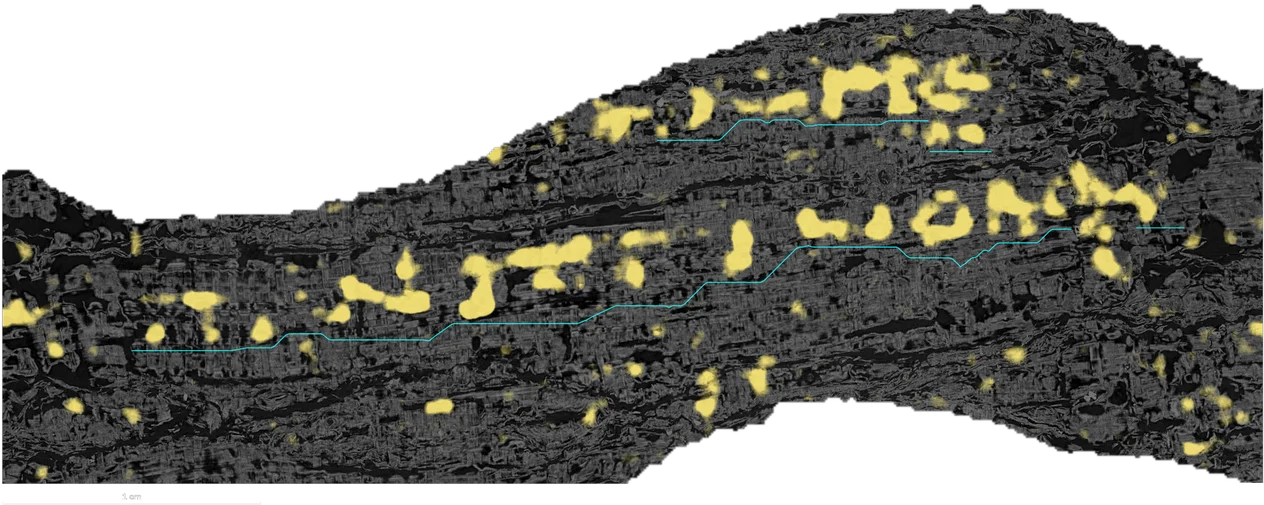
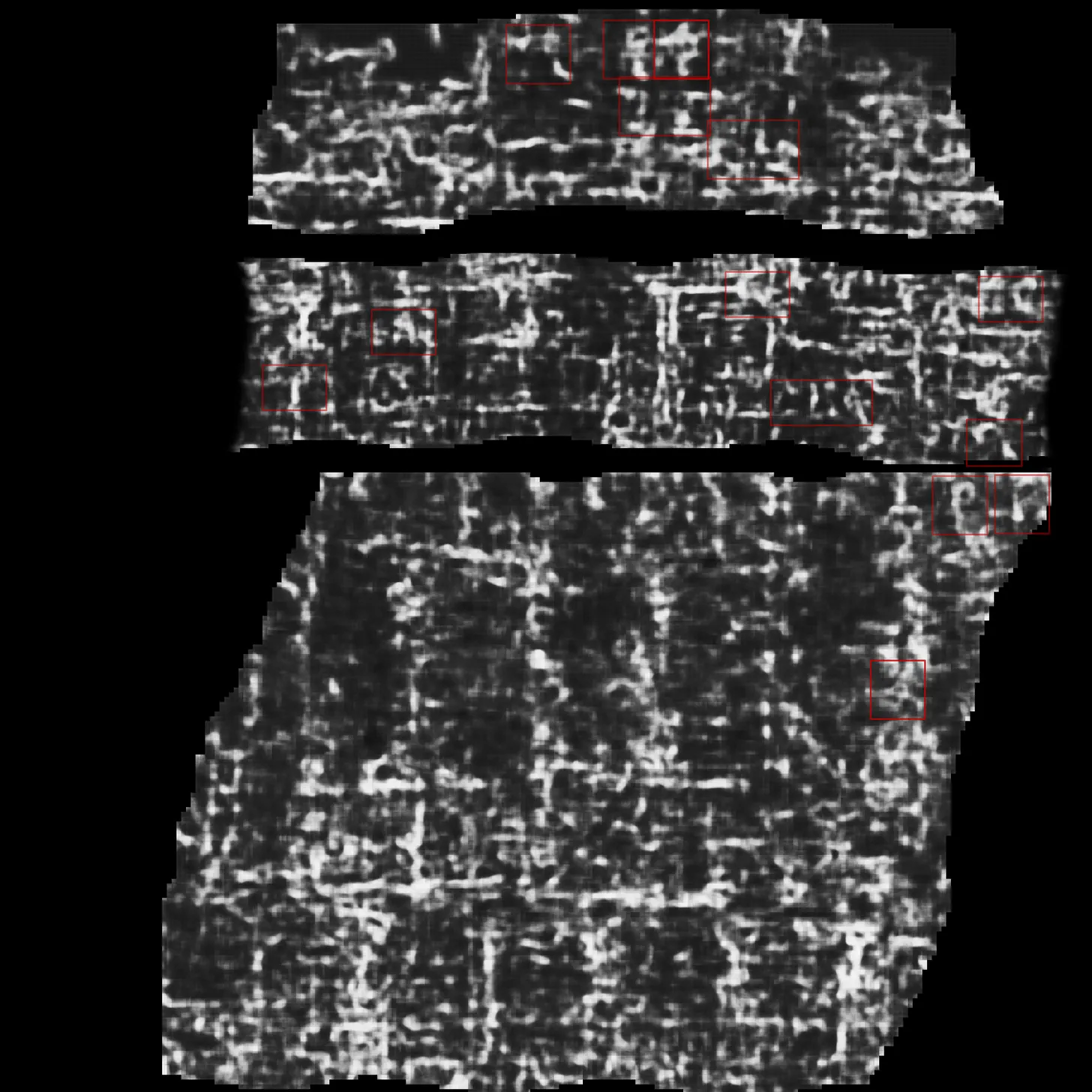
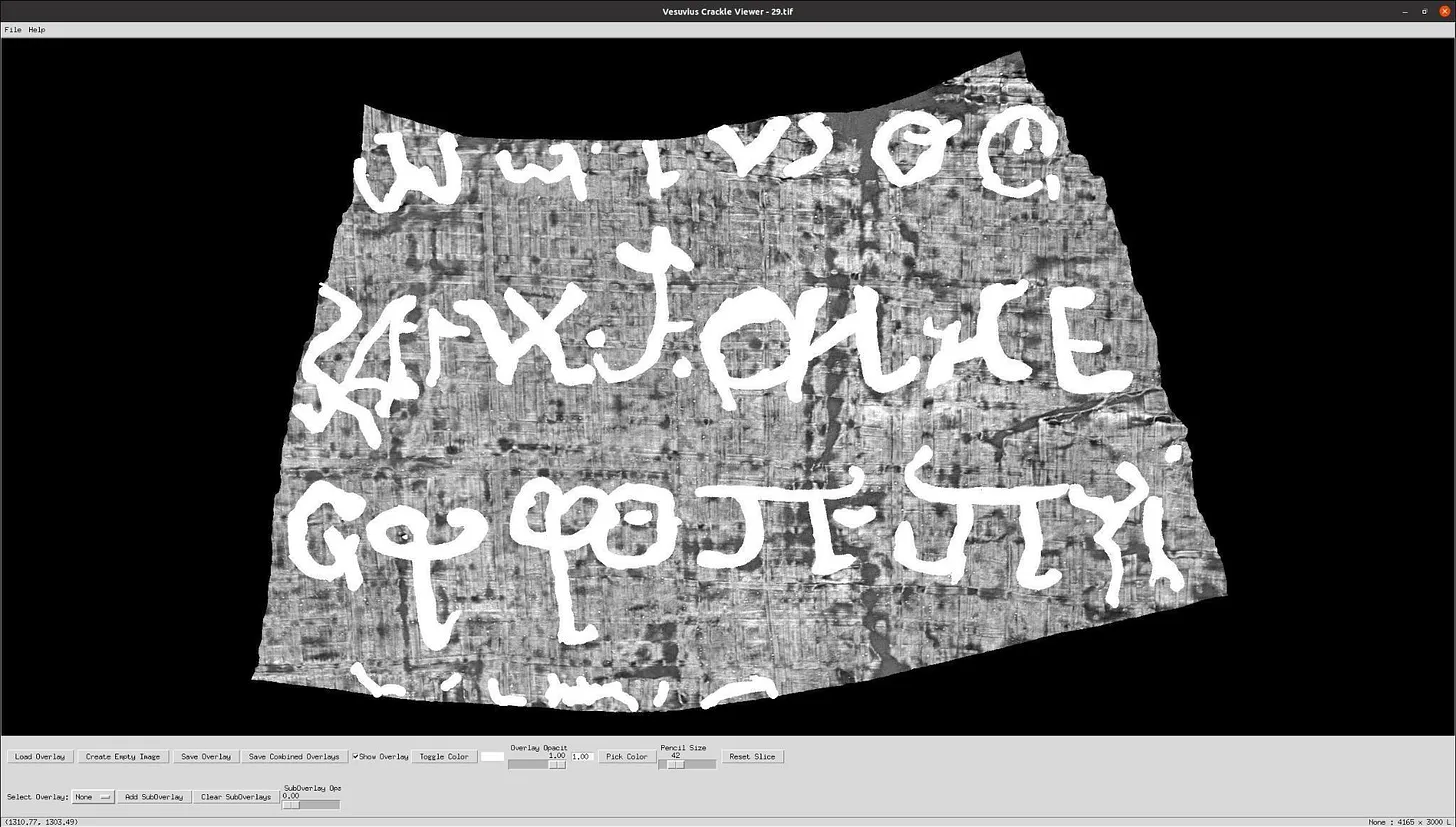
$50,000 First Letters: PHerc. 343 (October, 2026)
Goal: Find 10 letters within a 4 cm² area of a scroll where nothing has been read yet.
$40,500 Progress Prizes (September 2026)
Goal: Improve the tools and training methods needed to read the scrolls.
$20,000
Automated fiber extraction : Samir Lerognon / @qualzz
Fine-tunes existing fiber models on data from more scrolls, fits splines to the predicted fibers, and integrates the results with VC3D and the spiral fitter.
$5,000
ScrollFiesta pipeline : Ben Kyles / @hari_seldon and team
The ScrollFiesta pipeline now produces very clean surfaces over reasonably large areas of scrolls.
$5,000
reader-v2 ink model : Domenico Russo / @klavis223
An ink model distilled onto native 9.6 µm volumes, now seeing wide use in the community.
$1,000
PLatS : Houjing Huang
An interesting segmentation approach that trains a model to learn an instance embedding of papyrus sheets.
$1,000
Assigning patches to windings : Thomas Kelly / @thomas_35601
A promising approach to assigning surface patches to global windings.
$1,000
volcomp : Forrest McDonald / @forrest
A chunked compressor for scroll CT and model predictions, now supported in VC3D.
$500
Full-scroll inferences : Yupeng Tang / @ytang454
Ran full-scroll inferences with several team and community surface models.
$500
Scroll umbilici : Aleksei Drobkov / @alyalya1404
Produced umbilici for several prize scrolls.
$500
Ink detection experiments : Hyojun Kwon
Various ink detection experiments with manual and pseudo labels, measuring cross-scroll generalisation and more.
$500
Winding consistency checks : Sergei Evland
Spotted a non-trivial issue in find-inconsistent-windings, and built a tool that makes checking winding constraint consistency easier.
$500
ProbeGuide : Sebastien Chicoineau
An experiment on the benefit of filtering ink pseudo-labels by DINO feature similarity.
$500
Renderer memory fix : Christopher William Scheirer / @Chris Scheirer
Makes the renderer load only the chunks actually needed along the surface, greatly reducing memory use.
$500
Faster Hecate inference : Junfeng Lu / @Ausar
Faster Hecate inference, plus fine-tuning ink models and detailed comparisons.
$500
Lighter ink training tutorial : Marcel Gwerder / @mg02346
Makes the ink training tutorial download just the data needed to train (2.4 GB instead of 92 GB), plus other fixes.
$500
Winding annotation tool : Jashanjot Singh Gill and Nhat Nam Tran
A tool generating winding annotations for the spiral fitter.
$250
Assorted villa PRs : Christos Vasilopoulos / @chrisvas_12645
Several useful merged villa PRs.
$250
Assorted villa PRs : Kaden Pool / @thatguybrodie
Five merged villa PRs, including correcting the ink model's input layer selection.
$250
Assorted villa PRs : Santiago Pelufo / @spelufo
Several useful merged villa PRs.
$250
Ink ensembling : Alex Clark
Small quantitative improvements to ink detection via ensembling.
$250
Assorted villa PRs : Eugenio Giuseppe Nerelli / @nerln
Five merged villa PRs.
$250
Assorted villa PRs : Jonathan Marrs / @martian87
Assorted useful merged villa PRs.
$250
Horizontal flip in VC3D : Sebastien Andersson
Adds horizontal flip to VC3D's rotation preview.
$250
Lasagna on Windows : Armando Gaona de Stefani / @Armando_Gaona
Windows support fixes for Lasagna.
$250
Spiral fitting & ink on Windows : Shuhan Yang / @qizhiran
Windows support for the spiral fitting, flattening and ink workflows.
$250
Ink training leakage fix : Miika Kestilä
Fixes a data-leakage bug in 3D ink training.
$250
Spiralising PHerc. 0211 : Bryant Le
Spiralised and released a significant length of PHerc. 0211, plus a merged PR.
$250
Single-pass Hecate : Ryan Gurganious / @DarthCeltic85 and Daine Ball / @Clexious
Makes Hecate predict in a single pass, for a ~35% speedup.
$31,000 Progress Prizes (August 2026)
Goal: Improve the tools and training methods needed to read the scrolls.
$20,000
Patch-based unwrapping : William Stevens
Detects when the 2D alignments of overlapping patches imply incompatible 3D locations, drops the offending patches, and joins the rest into flattened components — around 365 cm² of coverage on PHerc. 1667.
$2,500
9 µm surface model & ScrollFiesta fixes : Ben Kyles / @hari_seldon and collaborators
A retrained 9 µm surface model distilled from 2.4 µm predictions, producing thinner and more continuous sheets with fewer blobs, plus bugfixes and improvements across the end-to-end ScrollFiesta unwrapping pipeline.
$1,000
Ink checkpoint benchmarking : Domenico Russo
Benchmarks all 14 released 9 µm ink checkpoints, and retrains from dense teacher labels instead of the sparse hand-labelled strips.
$1,000
Seeded sheet growing : Mihajlo Nestorović
A trained 3D model that grows a single papyrus sheet from a seed, along with a pipeline for generating harder sheet-level training data.
$1,000
How many depth slices? : Paulo Sergio Camillo / @pscamillo
Real training experiments on how many depth slices the 9 µm ink model actually needs.
$1,000
Lasagna & VC3D improvements : Santiago Pelufo
Seven merged villa changes, including Mac GPU flattening in Lasagna, a HiDPI scale bar, and assorted navigation and registration fixes.
$1,000
First Letters on PHerc. 0826 : Lutfiya Miller and Chris Müller
Ran the First Letters workflow end to end on PHerc. 0826 and published the images, commands, failures and costs — with plenty of useful insight for others attempting it — plus two merged PRs.
$1,000
nnInteractive label refinement : Benjamin Hamm
Applies nnInteractive to surface label refinement, producing labels much closer to the true surface (though with some remaining topological issues).
$500
Dense pseudo-labels & checkpoint repair : Erwin Nieuwlaar
Extends the ink training recipe with dense pseudo-labels from native 113 keV scans, and repairs a published Scroll 1 checkpoint whose untrained output layer was emitting blank predictions.
$500
Assorted villa fixes : Oleksandr Kozlenko
Several useful fixes across training, inference, coordinate scaling, validation metrics and CLI tools.
$500
Sustained PR work : TAUIL Abd Elilah
PR work throughout the month, including making vesuvius.predict preprocess CT the same way the model was trained.
$250
Shared disk cache : Praneeth Reddy
Makes villa's neural-tracing disk cache available to the general model workflow, so reruns stop redownloading the same chunks.
$250
Spiral fitting on Windows : Shuhan Yang
Gets the spiral-fitting tools building and running on Windows with lower compute resources, plus patches that cut render traffic and time on remote volumes.
$250
VC3D agent bridge fixes : Ryan Gurganious
Lets VC3D's agent bridge start Lasagna with the selected volume, and download large segments without reporting them missing.
$250
Checkpoint averaging : Armando Gaona de Stefani
Careful checkpoint-averaging experiments on the ink models.
$33,500 Progress Prizes (July 2026)
Goal: Improve the tools and training methods needed to read the scrolls.
$20,000
ScrollFiesta : Ben Kyles / @hari_seldon
Continued development of the automatic surface mesher: now villa-compatible (zarr in, tifxyz out), snaps to papyrus in the CT scan, and produces constraints for spiral fitting.
$2,500
Optimising patch connectivity : William Stevens
Identifies and removes problem areas that cause sheet switching, leaving a scaffolding of known-good patches; run across all of Scroll 4.
$1,000
Portable GPU kernels for ScrollFiesta : Alan Thompson
A Rust/CubeCL driver for ScrollFiesta's MLS-midpoint projection hotspot that runs on AMD, NVIDIA, and WGPU.
$1,000
Zarr 3 read fixes : Prasad Khake
Fixes multiscale zarr 3 reads in the Python vesuvius Volume and restores an opt-in chunk cache.
$1,000
Ink detection validation harness : Hyojun Kwon
A reworked ink-detection tutorial with proper held-out validation splits, plus an upstream OOM fix.
$1,000
windcheck : Josep Carreras
Detects self-intersections in tifxyz surfaces, catching silent wrap-crossing errors for large-scale filtering.
$1,000
TIFXYZ Doctor : Aviad Cohen
A deterministic QA and triage tool for tifxyz surface grids: metadata, consistency, distortion, and topology checks, plus a merged VC3D bounds fix.
$1,000
Faster decohesion augmentation : J. Miguel Giraldo
Vectorized the DecohesionTransform training augmentation, replacing a per-iteration GPU kernel loop.
$1,000
Reproducibility fixes & ROI inference : TAUIL Abd Elilah
Assorted merged fixes and ROI inference support, plus a negative-result analysis of cross-scroll ink-signal measurement.
$1,000
Spiral fitting on consumer GPUs : Shuhan Yang
Makes the official spiral fitter run on 12 GB cards and without the native vc C++ extension.
$1,000
tifxyz repair & tracing fixes : Erwin Nieuwlaar
Fixes tifxyz meta.json bounding boxes and rescales neural-tracing displacements for non-training voxel sizes.
$1,000
scroll-data-audit : Matteo Bulloni
Defect-hunting across the open-data catalog and volume-cartographer, with catalog metadata checks and merged VC3D fixes.
$1,000
fit_spiral fixes : Nicolas Dolegieviez
Four merged fixes making fit_spiral work on Windows and turning silently zeroed losses into loud failures.
$3,000 Progress Prizes (June 2026)
Goal: Improve the tools and training methods needed to read the scrolls.Announcement: Blog post
$12,000 Progress Prizes (May, 2026)
Goal: Improve the tools and training methods needed to read the scrolls.Announcement: Blog post
$200,000 Kaggle Surface Detection (March, 2026)
Goal: Optimize topologically accurate papyrus surface detection methods.Announcement: Blog post / Kaggle competition / Kaggle leaderboard
$1,000 Open Source (March, 2026)
Goal: Improve virtual unwrapping for the Surface Detection challenge.Announcement: Blog post
$1,000 Open Source (July, 2025)
Goal: Improve virtual unwrappingAnnouncement: Blog post
$2,500 Open Source (June, 2025)
Goal: Improve virtual unwrappingAnnouncement: Blog post
$7,000 Open Source (May, 2025)
Goal: Updates to toolingAnnouncement: Blog post
$60,000 First Title Prize (May, 2025)
Goal: Discover the end title of a sealed Herculaneum scroll.Announcement: Blog post
$7,000 Open Source (April, 2025)
Goal: Get us closer to reading entire scrolls Announcement: Blog post
$10,500 Open Source (February, 2025)
Goal: Get us closer to reading entire scrolls.Announcement: Blog post
$60,000 First Automated Segmentation (December, 2024)
Goal: Reproduce the 2023 Grand Prize segmentation result, but faster.Announcement: Blog post
$13,500 Open Source (December, 2024)
Goal: Increase the probability we read 90% of four scrolls in 2024.Announcement: Blog post
$2,500
Volumetric segmentation model : Tim Skinner / @Tim S, Lachlan Parker, John Skinner
$2,500
Ink labels : Nicola Bodill / @polytrope
$2,500
Interactive mesh refinement : James Darby / @james darby
$1,000
vesuvius-render : Johannes Rudolph / @jrudolph
$1,000
Electric field-based flattening : Yao Hsiao / @Yao Hsiao, Dalufishe / @Dalufish
$1,000
Data overlays in Khartes : Chuck / @khartes_chuck
$1,000
Optimized ink detection : Hendrik Schilling / @waldkauz
$1,000
Supervoxel-based segmentation methods : Forrest McDonald / @verditelabs
$1,000
Segmentation tools : William Stevens / @Will Stevens
$29,000 Open Source (November, 2024)
Goal: Increase the probability we read 90% of four scrolls in 2024.Announcement: Blog post
$10,000
Segment patch generation : Hendrik Schilling / @waldkauz
$10,000
vesuvius-c library : Forrest McDonald / @verditelabs
$2,500
Electric potential scroll flattening : Yao Hsiao / @Yao Hsiao, Dalufishe / @Dalufish
$2,500
Various datasets : Sean Johnson / @sean (bruniss), Hendrik Schilling / @waldkauz
$1,000
phalanx : Marcel Roth
$1,000
2D -> 3D labeling tool : James Darby / @james darby
$1,000
zarr_to_ome script : Chuck / @khartes_chuck
$1,000
New segment in title region : Elian Rafael Dal Prá / @err, Sean Johnson / @sean (bruniss)
$18,500 Open Source (October, 2024)
Goal: Increase the probability we read 90% of four scrolls in 2024.Announcement: Blog post
$2,500
Segmentation models : Sean Johnson / @sean (bruniss)
$2,500
Optimizing surface models : Hendrik Schilling / @waldkauz
$2,500
Surface mesh refinement : Hendrik Schilling / @waldkauz
$2,500
C library : Forrest McDonald / @verditelabs
$2,500
Zarr support in vesuvius-gui : Johannes Rudolph / @jrudolph
$1,000
Self-supervised pretraining for ink detection : Jorge García-Carrasco / @jgcarrasco
$1,000
Interactive segmentation improvements in Volume Cartographer : Hendrik Schilling / @waldkauz
$1,000
Segmentation toolkit improvements : William Stevens / @Will Stevens
$1,000
Umbilicus Maker : James Darby / @james darby
$1,000
Meshing high curvature segmentations : James Darby / @james darby
$1,000
Visualization canvas : Yao Hsiao / @Yao Hsiao, Dalufishe / @Dalufish
$48,500 Open Source (September, 2024)
Goal: Increase the probability we read 90% of four scrolls in 2024.Announcement: Blog post
$20,000
Fiber following : Sean Johnson / @sean (bruniss)
$10,000
Inkalyzer : Youssef Nader / @YoussefNader
$2,500
Fragment ink labeling : Youssef Nader / @YoussefNader
$2,500
Fast meshing and flattening : Hendrik Schilling / @waldkauz
$2,500
Meshes from volumetric labels : James Darby / @james darby
$2,500
vesuvius-gui improvements : Johannes Rudolph / @jrudolph
$2,500
Self-supervised ink detection : Jorge García-Carrasco / @jgcarracsco, Andoni Irazusta-Garmendia / @theleprechaun25
$1,000
Segmentation optimization : Hendrik Schilling / @waldkauz
$1,000
Volumetric labeling improvements : James Darby / @james darby
$1,000
Scroll Sleuth : Paul Geiger / @PaulG
$1,000
Small surface segmentation : William Stevens / @Will Stevens
$1,000
Data streaming in Khartes : Chuck / @khartes_chuck
$1,000
Vesuvius Ink Generator : Seth Stewart
$41,000 Open Source (August, 2024)
Goal: Increase the probability we read 90% of four scrolls in 2024.Announcement: Blog post
$10,000
Segment Browser : Johannes Rudolph / @jrudolph
$10,000
Volumetric instance labeling : James Darby / @james darby
$10,000
Khartes3D : Chuck / @khartes_chuck
$2,500
Rescaled fragment surface volumes : Johannes Rudolph / @jrudolph
$2,500
Flood fill for segmentation : Will Stevens / @Will Stevens
$2,500
Convert volumetric segmentations to meshes : James Darby / @james darby
$2,500
Ink detection patch aggregation report : Arefeh Sherafati / @arefeh, Lou Schlessinger / @ls_96
$1,000
wj-wt-ftt : Yao Hsiao / @Yao Hsiao, Dalufishe / @Dalufish
$11,000 Open Source (July, 2024)
Goal: Increase the probability we read 90% of four scrolls in 2024.Announcement: Blog post
$12,500 Open Source (June, 2024)
Goal: Increase the probability we read 90% of four scrolls in 2024.Announcement: Blog post
$29,000 Open Source (May, 2024)
Goal: Increase the probability we read 90% of four scrolls in 2024.Announcement: Blog post
$35,000 Open Source (April, 2024)
Goal: Increase the probability we read 90% of four scrolls in 2024.Announcement: Blog post
$20,000
3D ink detection : Ryan Chesler / @emel_ryan
$2,500
Mesh merging : Giorgio Angelotti / @Jordi
$2,500
Instance segmentation labels : James Darby / @james darby
$2,500
Unsupervised pretraining : Ryan Chesler / @emel_ryan
$2,500
New segments : Sean Johnson / @Bruniss
$1,000
Volumetric processing tools : Forrest McDonald / @VerditeLabs
$1,000
Point cloud comparison : Giorgio Angelotti / @Jordi
$1,000
Instance segmentation experiments : James Darby, Ryan Reszetnik, Liamo Pennimpede, Lucas Nelson
$1,000
Meshing and chunking : Santiago Pelufo / @spelufo
$1,000
Pipeline Visualize : Yao Hsiao / @Yao Hsiao
$42,500 Open Source (March, 2024)
Goal: Increase the probability we read 90% of four scrolls in 2024.Announcement: Blog post
$20,000
Rendering improvements : Giorgio Angelotti / @Jordi
$10,000
Multiresolution chunked volumes : Chuck / @khartes_chuck
$2,500
Volumetric ink detection : Jorge Villaescusa / @mojonero
$2,500
Volumetric segmentation labels : Tim Skinner / @Tim S
$2,500
Data improvements : James Darby / @james darby
$1,000
Segment-to-segment label mapping : Oliver Daubney / @O_D
$1,000
Cell viewer and segmentation comparison : Yao Hsiao / @Yao Hsiao
$1,000
Superpixels and cells : Santiago Pelufo / @spelufo
$1,000
Other segmentation axes, 3D ink labels : Sean Johnson / @Bruniss
$1,000
Colab notebook and ink labels : Nicola Bodill / @polytrope
$850,000 Grand Prize 2023 (December 31, 2023)
Goal: Reveal four passages within the scrolls.Announcement: Announcement page
$700,000
Winner : Youssef Nader, Luke Farritor, and Julian Schilliger
$50,000
Runner up : Lou Schlessinger and Arefeh Sherafati
$50,000
Runner up : Elian Rafael Dal Prá, Sean Johnson, Leonardo Scabini, Raí Fernando Dal Prá, João Vitor Brentigani Torezan, Daniel Baldin Franceschini, Bruno Pereira Kellm, Marcelo Soccol Gris, and Odemir Martinez Bruno
$12,000 Open Source (December 31, 2023)
Goal: Increase the probability the Grand Prize gets awarded.Announcement: Blog post
$25,000 Open Source (November 30, 2023)
Goal: Increase the probability the Grand Prize gets awarded.Announcement: Blog post
$8,000
Next-gen Volume Cartographer : Philip Allgaier / @spacegaier
$5,000
Segment Browser : Johannes Rudolph / @jrudolph
$5,000
Ink Detection Masks : Anton Repushko / @repushko
$1,000
Sharkbite fix : Chuck / @khartes_chuck
$1,000
Vesuvius Kintsugi : Giorgio Angelotti / @jordi45698
$1,000
Crackle Labels : Sean Johnson / @bruniss
$1,000
Omit : Timo Meireman / @timo_71099
$1,000
Segment Viewer by Yao Hsiao / @Yao_Hsiao and Dalufishe / @Dalufish
$1,000
Single-sheet Segmentation : Brett Olsen / @brett_olsen
$1,000
Multiple Contributions : Santiago Pelufo / @spelufo
$60,000 First Letters & Ink (October 12, 2023)
Goal: Find the first letters within the scrolls.Announcement: Announcement page
Goal: Help the segmentation team do larger and harder areas.Announcement: Blog post
$12,000 Ink Detection Followup (September 8, 2023)
Goal: Take the models from the Ink Detection Prize (see below) and apply them to the scrolls, to find letters.Announcement: Blog post
Goal: Help the segmentation team do larger and harder areas.Announcement: Blog post
$100,000 Kaggle Ink Detection (July 14, 2023)
Goal: Optimize fragment-based ink detection methods.Announcement: Blog post / Kaggle competition / More info
$10,000 Open Source (April 14, 2023)
Goal: Increase the probability the Grand Prize gets awarded.Announcement: Blog post / Live stream
Before and during the competition, EduceLab has put out various works. With these tools, they have laid the foundation for the community. While EduceLab members are ineligible for prizes, we want to recognize their efforts.